
Turkish citizenship by investment lets a foreign national apply for a passport on the strength of a qualifying investment defined in Turkish law. The route most investors choose is property: a buyer of qualifying real estate priced and valued at USD 400,000 or above is eligible to apply for Turkish citizenship, subject to legal requirements and official approval. The value has to be confirmed by an official valuation report, and the real estate has to be held for at least three years under an annotation on the title deed.
This page is the hub for Turkish citizenship by property: the current rules, the valuation changes of September 2026, the steps, the documents, the costs and the questions buyers ask most. Citizenship-eligible projects are marked in our property Turkey listings.
Last reviewed: 10 November 2026. Rules are updated from time to time, and we confirm the current requirements with the relevant authorities before every transaction.
Requirements for Turkish Citizenship by Property Investment
| Minimum investment | USD 400,000 in qualifying real estate (USD 250,000 before 13 June 2022) |
|---|---|
| How the value is proved | Three figures must each reach USD 400,000: the price written on the deed, the valuer's figure and the amount on the bank's foreign exchange purchase certificate (DAB) |
| Valuation report | Compulsory. Since the circular update of 28 September 2026 it can be used for 12 months (previously 6) and can be prepared by any valuation firm holding a licence from the Capital Markets Board, SPK |
| Holding period | An annotation on the title deed blocks any sale of the property for three years |
| Who is included | The investor, the investor's spouse and children under 18 |
| Residence in Turkey | None: no period of residence is required at any stage |
| Typical timeline | About 6 to 9 months from the first consultation, depending on the file |
| Legal basis | Article 12 of Turkish Citizenship Law No. 5901 and Article 20 of its implementing regulation; Land Registry (TKGM) circulars 2024/2 and 2024/4 |
What Changed in September 2026: Valuation Reports
The Land Registry and Cadastre Directorate (TKGM) updated two circulars by approvals dated 28 September 2026, and land registry offices have applied the new text since 29 September. Three points matter to investors:
- Validity: a valuation report used in a title deed transaction is now valid for 12 months instead of 6. If a change that affects the value is recorded on the title after the report date, a new report is still needed.
- Choice of valuer: reports for citizenship files were previously prepared by a single company, GEDAS. They can now come from any valuation firm holding a licence from the Capital Markets Board, SPK, chosen by the applicant or assigned automatically when the request is made through the Web Tapu system.
- Timing of the application: under the updated circular 2024/4, the gap between the valuation-based value certificate and the citizenship-related application can be up to 12 months, also up from 6.
The USD 400,000 minimum and the three-year annotation did not change. Our guide to the property valuation report for Turkish citizenship explains how the report is ordered and read.

Main Advantages of Turkish Citizenship by Investment
- Family in one application: a husband or wife and any children below 18 go on the investor's file. Children aged 18 or over can generally be included only if they are dependent, which has to be documented.
- No residence requirement: you do not have to live in Turkey before or after you apply.
- The asset stays yours: you hold full title, may use the home yourself or let it, and may sell once the three-year period ends.
- Dual citizenship: permitted under Turkish law. Check whether your own country permits it as well.
- Travel: a Turkish passport gives entry without a visa, or with a visa issued on arrival, to more than 110 destinations. The Schengen area, the United Kingdom and the United States still require a visa.
- Public services: citizens use public schools and the public health system on the same terms as other Turkish citizens.
- Military service: under Military Service Law No. 7179, men who become citizens after the age of 22, or who have already served in their previous country, are treated as having completed their service. Sons who become citizens as minors follow the general rules.
Citizenship also gives the right to live, work and register a company in Turkey without a separate permit. Before you invest, take legal and tax advice for your own situation, including the rules of your home country.
Ways to Get Turkish Citizenship
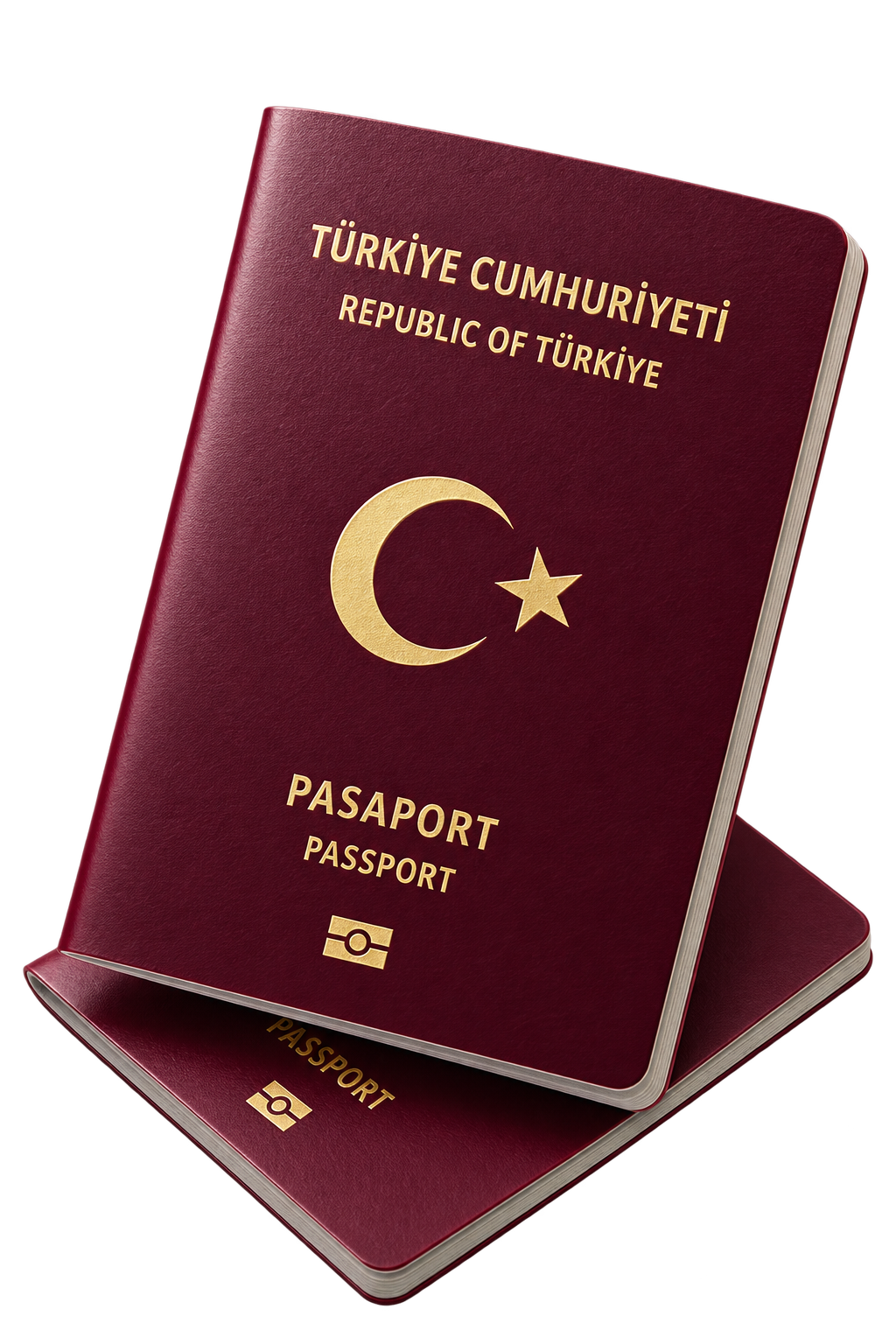
Turkish Citizenship Law No. 5901 provides four main routes: descent from a Turkish parent; marriage, on application after three years of marriage to a Turkish citizen; naturalisation after five years of continuous legal residence; and the exceptional route in Article 12, which covers investors. Investor files are decided without a residence period or a Turkish language test.
Investment Options for Turkish Citizenship
 Article 20 of the regulation lists seven routes. Property, deposits, bonds, fund units and pension contributions each carry a three-year holding condition:
- Real estate: at least USD 400,000
- Bank deposit in Turkey: at least USD 500,000
- Government bonds: at least USD 500,000
- Real estate investment fund or venture capital fund units: at least USD 500,000
- Private pension contribution: at least USD 500,000
- Fixed capital investment: at least USD 500,000
- Creating jobs for at least 50 people
Property is the most used route because the threshold is lower and the investor holds a tangible asset that can earn rent. We compare the programme with residence-by-investment schemes in Turkish citizenship vs golden visa programmes.

Which Properties Qualify for Turkish Citizenship?
Not every property in Turkey can be used for a citizenship application. Before you sign anything, the property and the seller both need to pass a set of eligibility checks. These are the main rules investors should know:
- Minimum value: the property (or properties) must reach the required investment amount, confirmed by an official valuation report from an SPK-licensed valuation firm.
- Title type: the property must have a proper title deed for a completed unit, or a qualifying title for a project under construction. Shares of a property, agricultural land and empty land without a lawful building do not qualify.
- Seller rules: the property is generally bought from a Turkish citizen or a Turkish company. Purchases between two foreign nationals, and certain sales between relatives or related companies, are not accepted.
- Not previously used: a unit that supported an earlier citizenship file cannot be used a second time.
- Several properties can be combined: you can buy more than one property to reach the minimum, as long as each one meets the rules.
- Off-plan purchases: under-construction properties can qualify when the full investment amount is paid in advance under a notarised sales contract and the required commitment is registered.
Because these checks are technical, our team reviews the title deed, the seller and the project status before you reserve a property. For more detail, read which properties qualify for Turkish citizenship and our guide to evaluating a property developer in Turkey.
The Valuation Report
For citizenship, the figure that counts is not only the price in the contract. An SPK-licensed valuation firm prepares an official report, and the declared price and the valuation must both reach the USD 400,000 minimum. If the valuation comes in below the agreed price, the property may not qualify on its own, which is why we check the expected valuation before you commit. Since 28 September 2026 the report can be used for 12 months and you are no longer tied to a single valuation company.
How Payment Works: Bank Transfer and Foreign Currency Conversion
The investment must be paid through the Turkish banking system so that it can be documented. In practice this means:
- The purchase amount is transferred from abroad to a Turkish bank account.
- The foreign currency is sold to the Central Bank through a Turkish bank, and the bank issues a foreign exchange purchase certificate (known as the DAB document).
- Payments are made to the seller by bank transfer, with records that match the title deed and the valuation report.
The deed price, the valuer's figure and the DAB amount must each reach USD 400,000; a higher figure in one cannot make up for a shortfall in another. Cash payments, or transfers that do not follow this route, cannot be used to prove the investment. Planning the payment correctly from the start is one of the simplest ways to avoid delays.
Turkey Citizenship by Investment Process: Steps and Timeline
A typical file moves through four stages: choosing an eligible property, the valuation and title deed transfer, the citizenship application, and the issue of identity cards and passports. In detail:
- Consultation and planning: we discuss your goals, family members to include, budget and timeline, and confirm which route suits you. Typical time: 1–3 days.
- Property selection and due diligence: we shortlist eligible properties and check the title deed, seller eligibility, permits and expected valuation. Typical time: 1–3 weeks.
- Tax number and bank account: the tax office issues your number and a bank opens an account in your name. This can usually be arranged with a power of attorney if you are not in Turkey. Typical time: 1–5 days (often the same day for the tax number).
- Payment and currency conversion: funds are transferred and converted, and the DAB document is issued. Typical time: 1–3 days once funds arrive.
- Valuation and title deed transfer: the valuation report is prepared, the deed passes into your name and the three-year holding note is entered. Typical time: 1–2 weeks.
- Certificate of conformity and residence permit: the investment is confirmed by the relevant ministry, and you apply for a residence permit, which is required before the citizenship application. Typical time: 2–6 weeks.
- Citizenship application and passport: the application is submitted with your documents and biometric data. After approval, Turkish ID cards and passports are issued for you and your eligible family members. Typical time: 3–6 months after the application is filed.
Added together, most families should plan for roughly 6 to 9 months from the first consultation to passports in hand. The investment and title deed stages are usually completed within a month; the waiting time is mainly the official review of the citizenship file.
Processing times depend on how complete the file is and on the workload of the authorities. Read about common reasons for delays and rejections to understand what keeps an application moving.
Documents You Will Need
The exact list depends on your nationality and family situation. Most files include the following.
For the investor and family members
- Valid passports for the investor, spouse and children
- Birth certificates, and a marriage certificate or other proof of civil status
- Biometric photographs
- The citizenship application form, completed at the application
- Residence permit cards and Turkish tax numbers
- Where requested, a criminal record certificate from your home country
- For a child applying with one parent, the other parent's notarised consent
For the investment
- Title deed showing the three-year annotation
- Official valuation report
- Bank receipts and the foreign exchange purchase certificate (DAB)
- Certificate of conformity issued for the investment
Documents issued abroad generally have to be apostilled, or legalised at a consulate, and then translated into Turkish by a sworn translator. Preparing them early saves weeks later in the process.
Turkish Citizenship by Investment Cost
The investment amount is only part of the budget. When planning a citizenship purchase, you should also allow for:
- Title deed transfer tax and land registry fees
- The official valuation report
- Translation, notary and apostille fees
- Legal and consultancy fees
- Residence permit, application and passport fees
- Ongoing ownership costs such as property tax, building management fees and insurance
Costs depend on the property, the number of family members and current official fees, so we prepare a personalised cost breakdown before you commit. Two guides go further: total cost of buying property in Turkey and annual costs of owning property in Turkey.
The table shows typical amounts for a USD 400,000 purchase by a family of four. Lira amounts are converted at about 50 TL per US dollar (early November 2026).
| Cost item | Typical amount (TL) | Typical amount (USD) | Notes |
|---|---|---|---|
| Title deed fee (tapu harci) | about 800,000 | about 16,000 | 4% of the declared value; half falls on each party in law, though the buyer usually covers the whole amount |
| Valuation report | from 17,622 plus VAT | from about 350 | 2026 minimum tariff of the Capital Markets Board (SPK) for a dwelling no larger than 250 m² (gross); firms may charge more. The valuation has to come out at USD 400,000 or above, and the report is valid for 12 months |
| VAT on a new-build unit | 0 with the exemption | 0 with the exemption | Foreign buyers paying in foreign currency can be exempt on a developer's first sale; otherwise 1% to 20% |
| Legal fees | about 200,000 | about 4,000 | Lawyers often charge around 1% of the price; fixed-fee packages are also common |
| Translation, notary and power of attorney | about 15,000 – 40,000 | about 300 – 800 | Sworn translations of passports and birth or marriage certificates, plus apostilles from your home country |
| Residence permit and health insurance | varies by nationality and age | varies | Needed for each family member while the citizenship file is processed |
| Turkish passports (10-year) | 14,761 each | about 295 each | 2026 official fee including the booklet fee; about 59,000 TL for four people |
| DASK earthquake insurance | 885 – 5,000 a year | about 18 – 100 a year | Required before the title deed transfer |
Sources: 2026 passport fee schedule (Global Citizen Solutions summary of official fees), the Capital Markets Board minimum valuation tariff for 2026 (Official Gazette, 31 December 2025), Antalya Homes purchase cost guide (November 2026), Turkish VAT Law article 13/i, exchange rate from TCMB-based market quotes on 3 November 2026. Fees change each year, so ask for a written quote before you start.
After Citizenship: The Three-Year Holding Period
A three-year bar on selling is entered on the title deed. During this period you keep full ownership: you can live in the property, use it as a holiday home or rent it out. Many owners use property management services so the property is looked after while they live abroad. If you plan to rent it, read our guide to short-term rental rules in Turkey.
When the holding period ends, the restriction is lifted and you are free to keep or sell the property. Your citizenship is not affected by a sale made after the holding period. Taxes on a future sale depend on how long you have owned the property, so it is worth getting advice before you sell. Read our guide on selling property in Turkey as a foreigner.
Why Work With a Licensed Consultant?
Most problems in citizenship files come from avoidable mistakes: a property that does not qualify, a valuation below the required amount, a payment made through the wrong channel or missing documents. Bigist Invest is a licensed consultancy that combines property selection with legal support, so the same team follows your file from the first consultation to passport delivery. We help you:
- Shortlist properties that meet the citizenship rules
- Check the developer, the title deed and the seller before you pay
- Plan the payment and currency conversion correctly
- Prepare and submit your documents
- Manage the property after purchase if you live abroad
Start by browsing our property for sale in Turkey or read our property buyers guide. If you are wondering whether buying is right for you, see how safe it is to buy property in Turkey.
Watch: How to Buy Property in Turkey and Get Turkish Citizenship
More videos on our YouTube channel.
Turkish Citizenship by Investment: Detailed Guides
Each guide below covers one part of the subject in more depth:
- Can you get Turkish citizenship by buying property? Questions and answers
- Which properties qualify for Turkish citizenship?
- How the USD 400,000 investment amount works
- Turkish citizenship for families: spouse and children
- The property valuation report for citizenship
- Off-plan vs ready property for citizenship
- Choosing a citizenship property that holds its value
- Why citizenship applications get delayed or rejected
- Dual citizenship and Turkish citizenship by investment
- Turkish citizenship vs golden visa programmes
- Turkish citizenship for Pakistani citizens
- Turkish passport benefits: visa-free travel, E-2 visa and more
Frequently Asked Questions
How much must I invest in Turkey to get citizenship?
At least USD 400,000 in qualifying real estate, held for three years. The other routes start at USD 500,000 (a bank deposit, government bonds, fund units, a private pension contribution or fixed capital), or you can create 50 jobs. Every route leads to an application that is subject to legal requirements and official approval.
Does buying a house in Turkey give me citizenship?
Buying a house or apartment does not grant citizenship by itself. If the official valuation puts it at USD 400,000 or above, the price is paid through a Turkish bank and the title carries the three-year annotation, you become eligible to apply, subject to legal requirements and official approval.
What is the timeline for Turkish citizenship by investment?
Most families should plan for about 6 to 9 months from the first consultation to passports. The purchase and title deed stages usually take about a month; the rest is the official review, which has no guaranteed duration.
How hard is it to get Turkish citizenship by investment?
There is no language test and no minimum stay. The difficulty lies in the paperwork: an eligible property and seller, a valuation at or above the minimum, a clean payment trail through the bank and complete family documents. The authorities also carry out background checks before they decide.
What is the total cost of Turkish citizenship by investment?
Beyond the USD 400,000 price, the largest extra is the title deed fee of 4% (about USD 16,000), followed by the valuation report, legal and translation fees, residence permits and passports. The cost table above shows typical amounts for a family of four.
Which properties can be used for Turkish citizenship?
Residential and commercial properties can qualify if they meet the programme requirements, pass an independent valuation and have not previously been used for a citizenship application. See which properties qualify and browse the citizenship-eligible projects in our property in Turkey listings.
Can more than one property be used to reach the investment amount?
Yes. More than one property can be used for a single application, provided the combined investment and other requirements are met. Read more about how the investment amount works.
Does my family become eligible too?
Yes. A husband or wife and any children below 18 go on the same file as the investor. Our family guide explains the documents required.
Why is the valuation report important?
An independent valuation confirms that the property's value meets the requirement. If the valuation is lower than expected, the property may not qualify on its own. Learn more about the valuation report.
What can delay a citizenship application?
Most delays come from valuation issues, incomplete payment records, document errors or title deed problems. See our checklist of common reasons for delays and rejections.
When can the property be sold?
Not during the three-year annotation on the title deed. Once that period ends the restriction is lifted and you can sell without any effect on your citizenship. Choosing a property with strong resale demand protects your investment; see how to choose a property that holds its value.
What if I only want to live in Turkey, not become a citizen?
A residence permit may be enough. Compare the short-term residence permit and the family residence permit.
Do I need to visit Turkey to apply for citizenship?
Much of the process can be handled with a power of attorney, including the purchase and title deed transfer. You will usually need to be present for steps that require biometric data, such as the residence permit and citizenship application.
Does an off-plan property count for citizenship?
Yes, an under-construction property can qualify if the required amount is paid in advance under a notarised sales contract and the project has the correct title type. We check this before you reserve.
What is the DAB document?
The DAB is the foreign exchange purchase certificate issued by a Turkish bank when your foreign currency is converted through the Central Bank. It proves that the investment came from abroad through the banking system.
May I let the property while the three-year restriction applies?
Yes. The three-year commitment only stops you from selling the property. You can live in it, use it occasionally or rent it out.
Can my adult children be included?
The application covers your spouse and any child under 18. Children aged 18 or over can generally be included only if they are dependent, which must be supported with documents.
Is dual citizenship allowed?
Turkish law accepts a second nationality. Your home country may not, so check its rules before you apply.
How long is the valuation report valid?
Twelve months. The Land Registry circular update of 28 September 2026 extended the period from six months to twelve. A new report is still required if a change that affects the value is recorded on the title after the report date.
Can I buy a commercial property instead of a home?
Yes, a commercial property such as a shop or office can be used if it meets the same title, valuation and seller rules as a residential property.
Ready? Let's Get Started.
Tell us your budget and who will be included in the application, and our team will prepare a shortlist of citizenship-eligible properties.
Looking for a residence permit instead? See our student, short-term and family residence permit guides.